


Buying a house? Exciting, right? But let’s be honest, the thought of negotiating the price can feel a little… daunting. Maybe you envision tense back-and-forths, or worry about saying the wrong thing and losing out on your dream home.
Don’t worry! Negotiation in house buying isn’t a scary battle. Think of it as a strategic conversation – a chance to find common ground and reach a win-win agreement. And guess what? You absolutely can become a confident and successful negotiator.
🔑 Key Takeaways for House Buying Negotiation Success
- Before you even think of making an offer, research prices, understand property values, and know your financial standing.
- Negotiation is about strategy, not aggression. Start smart with your offer, play it cool, and know when to walk away.
- Beyond the Price Tag. Think about the whole deal. Flexible timelines, desirable buyer status, and even fixtures can be your negotiation tools.
Why Negotiation is Your Secret Weapon When Buying a House
Buying a house is like shopping for a car—you wouldn’t pay the sticker price without negotiating. The asking price is just a starting point, so negotiation is key.
Why is it so crucial?
- Save Serious Money: Successfully negotiating even a small percentage off the asking price can translate into thousands of dollars saved. Think of what you could do with that extra cash – renovations, furniture, or simply a healthier bank balance!
- Get the Best Value: Negotiation ensures you pay a fair price based on the property’s actual value. Are repairs needed? Is the market cooling down? It helps you adjust for these factors.
- Empower Yourself in the Process: Negotiating puts you in control. You’re not just passively accepting the seller’s terms. You’re actively participating in shaping the deal to fit your needs and budget.
Preparing for a House Buying Negotiation
Before making an offer, gather all the information you can. Preparation isn’t just helpful; it’s essential.
Here’s where to start:
1. Researching Local House Prices
Understanding local house prices is non-negotiable. It gives you a realistic benchmark and prevents you from overpaying.
How do you become a market expert?

A. Online Property Portals
Websites like Zillow, Realtor.com, Redfin (and local equivalents) are goldmines. Search for comparable properties in your desired neighborhood. Pay attention to:
- Asking Prices: See what similar homes are listed for.
- Sold Prices: Crucially, look at sold prices of recently sold homes. This is real-world data! Many sites provide this information.
- Days on Market: How long are properties staying on the market? Longer listing times can indicate a cooler market, potentially giving you more negotiation leverage.
B. Estate Agent Insights
Talk to local real estate agents (even if you’re not using one to buy). They have their finger on the pulse of the local market. Ask them about:
- Current Market Trends: Is it a buyer’s or seller’s market?
- Average Prices in the Area: Get their expert opinion on typical prices for homes like the one you’re interested in.
C. Land Registry (Public Records)
In many regions, you can access public records of property sales, often through a land registry or county recorder’s office. This is official, verified data.
Actionable Tips:
- Create a spreadsheet.
- List comparable properties you find online.
- Note down: address, asking price, sold price (if available), bedrooms, bathrooms, square footage, condition (from listing descriptions and photos), and days on market. This visual comparison will make you a market whiz in no time!
By doing your homework, you’ll walk into negotiations armed with solid data, not just guesswork. You’ll know if the asking price is realistic, inflated, or even a bargain!
2. Property Value: Look Beyond the Asking Price Tag
The asking price is just that – an asking price. It’s not necessarily the value of the property. As a smart negotiator, you need to look deeper and assess the true value.
Factors that Impact Property Value (Beyond the Listing Price):
- Property Condition:
- Cosmetic Condition: Freshly painted and staged? Or dated and needing TLC? Cosmetic updates are cheaper to fix than…
- Structural Condition: Are there signs of roof issues, foundation problems, outdated plumbing or electrical? These can be major expenses. A survey (which we’ll discuss later) is crucial to uncover these.
- Location, Location, Location:
- Desirability of Neighborhood: Are schools top-rated? Is it a safe and quiet area? Are there amenities nearby (parks, shops, restaurants)? Highly desirable locations command higher prices.
- Proximity to Amenities & Commute: Easy access to public transport, major roads, and workplaces increases value.
- Noise & Outlook: Is the property on a busy street? Overlooking a less-than-scenic view? These can detract from value.
- Market Conditions:
- Buyer’s vs. Seller’s Market: In a buyer’s market (more homes for sale than buyers), you have more negotiating power. In a seller’s market (more buyers than homes), competition is higher.
- Interest Rates: Rising interest rates can cool down the market, potentially giving buyers more leverage.
- Economic Climate: Local and national economic factors influence housing demand and prices.

Actionable Tip:
- During property viewings, be observant! Don’t just admire the staging.
- Look for signs of wear and tear, potential issues, and consider the location objectively.
- Think like an appraiser: “Needs new roof in 5 years? Factor that into my offer.”
Understanding these factors helps you determine if the asking price aligns with the real value. If a house needs significant work, or is in a less desirable spot within the neighborhood, its value might be lower than comparable listings in pristine condition in prime locations. Negotiation is how you bridge that gap.
3. Get Your Finances Solid: Mortgage in Principle & Proof of Funds are Your Allies
Sellers want to know you’re a serious buyer – someone who can actually close the deal. Having your finances in order isn’t just smart for you, it’s a powerful negotiation tool.
Key Financial Preparations:

a. Mortgage in Principle (MIP) / Decision in Principle (DIP)
Get pre-approved for a mortgage! This is a statement from a lender estimating how much they’d be willing to lend you, based on a preliminary financial review.
- Why it’s crucial: It shows sellers and agents you’re a qualified buyer. It speeds up the process once your offer is accepted. It gives you a realistic budget.
- Actionable Tip: Get your MIP/DIP before you start seriously house hunting. It will save you time and stress later.
Looking for a smooth and efficient way to get your Mortgage in Principle? Stagg Mortgage Services specializes in helping homebuyers like you secure their MIP/DIP quickly and easily. We guide you through the process, ensuring you have this crucial document in hand, demonstrating to sellers that you are a serious and prepared buyer.
B. Proof of Funds (for Deposit)
Be prepared to show proof you have the deposit money readily available. This might be bank statements, investment account statements, etc.
- Why it matters: Again, it demonstrates you’re a serious and financially sound buyer. It can be especially important if you’re making a cash offer (which we’ll touch on later).
C. Understand Your Budget Limits
Know your absolute maximum you’re willing and able to spend. This isn’t just the mortgage amount; it includes closing costs, moving expenses, and a financial cushion for the unexpected.
- Actionable Tip: Create a detailed budget! Factor in all costs associated with buying and owning a home. Don’t just focus on the monthly mortgage payment.
How Financial Preparation Strengthens Your Negotiation Position:
- You’re a Desirable Buyer: Sellers prefer buyers who are financially ready. It reduces the risk of the deal falling through due to financing issues.
- Faster Closing: Pre-approved mortgage = faster closing process. This can be attractive to sellers who need to move quickly.
- Confidence: Knowing your financial limits gives you confidence in negotiations. You won’t be swayed by emotion into overspending.

Actionable Tip: Mention your MIP/DIP and financial readiness through Stagg Mortgage Services’ Agreement in Principle when making your offer. It signals to the seller that you’re prepared and serious. This can give you an edge over other potential buyers.
Making Your Offer: Crafting the Perfect Initial Bid
Okay, you’ve done your research, you understand property values, and your finances are in order. Now for the exciting part – making an offer! Your initial offer sets the stage for the entire negotiation process.
Think of your offer as the opening move in a strategic game. It needs to be thoughtful, not just emotional. Let’s explore how to craft a winning initial bid:
Why a Lower Initial Offer Can Be a Winning Move
“Start low” – you’ve probably heard this advice. But is it always the right strategy? And how low is “low”?
The Logic Behind a Lower Initial Offer:
- Creates Negotiation Room: Starting below asking price leaves space for back-and-forth. It’s almost expected in many markets. If you start at asking price, where do you go from there?
- Signals Value Awareness: A lower offer (when justified by your research) signals to the seller that you’ve done your homework and understand the market value. You’re not just blindly accepting their price.
- Prevents Overpaying: It’s less risky to start low and increase than to overbid initially and then regret it.
- Tests Seller Motivation: A lower offer can gauge how motivated the seller is to sell. Are they firm on price, or are they willing to negotiate?
How “Low” is Too Low?
- Market Context Matters: In a hot seller’s market, a drastically low offer might be immediately dismissed. In a cooler market, or for a property that’s been on the market for a while, a lower offer is more reasonable.
- Property Condition: If the house needs significant updates or repairs, a lower offer is more justified.
- A Good Starting Point: 5-10% Below Asking Price: This is a common guideline in many markets. It’s low enough to create negotiation room, but not so low as to be insulting (in most cases). However, this is just a guideline, not a rigid rule.

Example: Asking price is $400,000. A 5% lower offer would be $380,000. A 10% lower offer would be $360,000. Choose based on your market research and property assessment.
Important Note: Don’t be unrealistically low. A “cheeky offer” (like 20-30% below asking) might offend the seller and shut down negotiations before they even begin, especially if the property is reasonably priced for the market. The goal is to start a conversation, not an argument.
Actionable Tip:
- Base your initial offer on your research, not just a random percentage.
- Be prepared to explain your reasoning if asked. “Based on comparable sales in the last 3 months, and factoring in the needed updates to the kitchen and bathrooms, my offer is…”
When to Flex Your Muscles: Situations for a Strong Initial Offer
“Start low” is generally good advice, but there are times when a stronger initial offer might be the strategic move. It’s about reading the situation and adapting your approach.
Scenarios Where a Stronger Offer Might Be Smart:
- Highly Competitive Market (Seller’s Market): If homes are selling quickly and with multiple offers, starting too low could mean losing out. You might need to be more aggressive to get noticed.
- “Dream Home” Scenario: If this is the perfect house for you, and you’re worried about competition, a stronger initial offer can show you’re serious and reduce the risk of losing it.
- Sealed Bids or Multiple Offer Situations: In sealed bids, you only get one shot. Your initial offer has to be your best offer. In multiple offer situations, a strong offer can make you stand out.
- Desirable Property, Fair Price: If your research shows the property is already priced fairly for the market and is in excellent condition, a low offer might be less likely to be accepted. A near-asking or slightly below asking offer might be more appropriate.
- Avoiding a Drawn-Out Negotiation: If you value speed and want to avoid a lengthy back-and-forth, a stronger initial offer can expedite the process.
“Stronger” Offer Strategies:
- Offer Closer to Asking Price: Instead of 5-10% below, consider offering closer to asking, or even at asking price if you’re in a very competitive situation.
- “Clean” Offer: Minimize contingencies (like financing or inspection contingencies, if you are comfortable doing so – but be cautious!). A “clean” offer is more attractive to sellers as it reduces potential roadblocks.
- Express Strong Interest & Readiness: Convey your enthusiasm for the property and emphasize your financial readiness to close quickly.
Important Note: Even in these situations, avoid overpaying. Set your maximum budget and stick to it. A “stronger” offer doesn’t mean abandoning your financial discipline. It means being more competitive within your pre-determined limits.
Actionable Tip: Assess the market conditions and your personal priorities (dream home vs. budget sensitivity). If it’s a competitive situation or a truly perfect property, be prepared to be more aggressive with your initial offer, but always within your financial comfort zone.
The 5% Rule (or Is It?)
You’ll often hear about the “5% rule” – offering 5% below asking price as a starting point. Is this a magic number? Is it always applicable?
The 5-10% Guideline – A Useful Starting Point:
- Common Practice: Offering 5-10% below asking has become a fairly common initial offer strategy in many real estate markets. It’s a recognized starting point for negotiation.
- Creates Room to Move: As we’ve discussed, it leaves space for negotiation and counteroffers.
- Reasonable in Many Markets: In typical market conditions, it’s often considered a reasonable starting offer that won’t be immediately dismissed as too low.
Why It’s NOT a Rigid Rule:
- Market Variations: In a hot seller’s market, 5% below might be too low and easily rejected. In a cooler buyer’s market, or for an overpriced property, 10% or even more below might be appropriate.
- Property Specifics: Condition, location, and unique features of the property itself should influence your offer, not just a blanket percentage. A house needing extensive renovations warrants a larger discount than a move-in ready home.
- Asking Price Accuracy: Is the asking price realistic to begin with? If the property is already underpriced to attract multiple offers, a 5% reduction might be pointless.
Think of it as a Guideline, Not a Law:
- Use it as a starting point for consideration. Don’t blindly apply it without thinking.
- Adjust based on your market research and property assessment. Is the market hot or cold? Is the house in great shape or needing work? Is the asking price realistic?
- Be prepared to deviate from the 5-10% range if the situation warrants it. Sometimes a higher initial offer is needed; sometimes a lower one is justified.
Actionable Tip:
- Don’t get fixated on the “5% rule.”
- Instead, focus on your market research and property evaluation.
- Let those factors guide your initial offer, and use the 5-10% guideline as a reference point, not a strict rule.
It’s Not Just About the Price
Price is obviously a major factor in house negotiations, but it’s not the only factor that matters to sellers. Thinking beyond just the dollar amount can give you a significant negotiation advantage.
What else can you “negotiate” or offer to make your bid more attractive?
“Sweeteners” to Include in Your Offer:
1. Flexibility on Closing Date:
- Seller Convenience: If the seller needs a quick closing, or conversely, needs extra time to move out, being flexible with the closing date can be very appealing. Ask the agent about the seller’s ideal timeline.
- Example: “We are flexible and can close within 30 days, or adjust to the seller’s preferred timeframe.”
2. Deposit Amount:
- Stronger Commitment: A larger earnest money deposit (the money you put down to show you’re serious after offer acceptance) can signal stronger commitment and financial stability.
- Typical Range: Deposits are often around 1-3% of the purchase price, but in competitive situations, a slightly higher deposit might be considered a sweetener.
3. Contingencies (or Lack Thereof – Use with Caution):
- Financing Contingency: This protects you if you can’t secure a mortgage. Waiving it (if you are absolutely certain of your financing and comfortable with the risk) can make your offer more attractive, but it’s risky!
- Inspection Contingency: This allows you to back out if major issues are found during inspection. Waiving it is highly risky and generally not recommended unless you are extremely comfortable with the property’s condition and potential risks.
- Appraisal Contingency: Protects you if the house appraises for less than your offer. Waiving it (again, risky) can strengthen your offer but could mean you have to make up the difference in cash if the appraisal comes in low.
- Actionable Tip: Think carefully before waiving contingencies. It can make your offer stronger, but it also removes buyer protections. Consult with your real estate agent and financial advisor before considering this.
4. Cash Offer (If Applicable):
- Speed and Certainty: Cash offers are highly desirable because they eliminate mortgage financing risk and often lead to faster closings.
- Negotiating Power: Cash buyers often have more negotiating leverage due to the certainty and speed they offer.
5. Limited or Specific Repair Requests (After Inspection):
- Reasonable Requests: After inspection, focus on requesting repairs for major issues (safety, structural). Being flexible on minor cosmetic items can make your offer smoother.
- Compromise: Consider asking for a price reduction or closing cost credit instead of demanding specific repairs for certain items.
Actionable Tip: Talk to your real estate agent about which “sweeteners” might be most effective in your specific situation and market. They can advise you on local norms and seller preferences. Tailor your offer to be both financially sound and appealing to the seller.
Using the Property Survey
The property survey (or home inspection) is not just about protecting yourself from buying a lemon. It’s also a powerful negotiation tool. The survey report can reveal issues that can justify a price reduction.
How to Leverage Survey Findings for Negotiation:
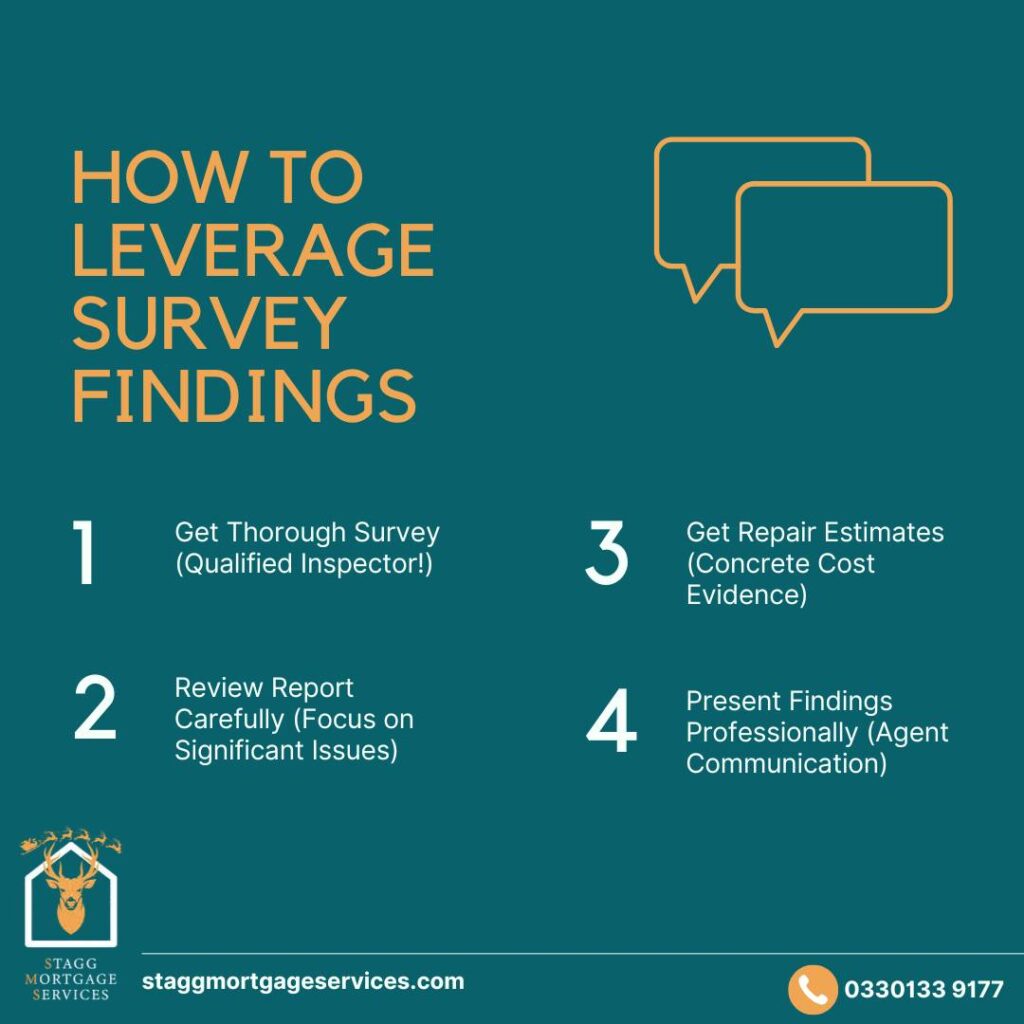
- Get a Thorough Survey: Don’t skimp on the survey! Choose a reputable, qualified surveyor to conduct a detailed inspection of the property’s structure, systems (plumbing, electrical, HVAC), and potential issues.
- Review the Report Carefully: Read the survey report thoroughly. Identify any significant issues flagged by the surveyor. Focus on items categorized as “major defects,” “urgent repairs,” or “further investigation required.”
- Focus on Significant Issues: Negotiate based on material defects – structural problems, roof issues, major plumbing or electrical faults, damp/mold, etc. Cosmetic issues are less likely to be successful negotiation points unless they are extensive.
- Get Repair Estimates: For significant issues, get quotes from qualified contractors to estimate the cost of repairs. This provides concrete evidence of the financial impact of the problems.
- Present Findings to the Seller (Through Your Agent): Your agent will communicate the survey findings and repair estimates to the seller’s agent. Be professional and factual, not accusatory.
- Negotiation Options After Survey:
- Price Reduction: The most common outcome. Request a price reduction to cover the estimated repair costs (or a portion thereof).
- Seller Pays for Repairs: Ask the seller to fix the identified issues before closing. This might be suitable for certain types of repairs.
- Closing Cost Credit: Request a credit towards your closing costs to offset repair expenses.
Important Notes on Survey Negotiation:
- Reasonable Requests: Be reasonable in your requests. Don’t nickel and dime over minor cosmetic issues. Focus on significant, costly defects.
- Market Context Matters: In a hot seller’s market, sellers might be less willing to negotiate on repairs, knowing they have other buyers waiting. In a cooler market, they might be more flexible to keep the deal alive.
- Walk Away Option: Be prepared to walk away if the seller is unwilling to negotiate reasonably on significant survey findings. Your survey is for your protection!
Actionable Tip: Factor the potential for survey negotiations into your initial offer strategy. You might start slightly lower than you would otherwise, knowing that the survey could reveal further negotiation opportunities. But always be prepared to proceed fairly and reasonably based on the survey results.
When a “Cheeky Offer” Can Actually Pay Off (Yes, Really!)
“Cheeky offer” – it sounds disrespectful, even insulting, right? Generally, you want to avoid being truly cheeky and offensive in your offer. However, in certain specific situations, a strategically low offer – what some might call “cheeky” – can actually be a smart move and pay off.
Situations Where a Lower Offer Might Be Strategic (Not Just Cheeky):
- Property Has Been on the Market for a Long Time: If a house has been listed for weeks or months without selling, it suggests the seller may be getting anxious and more motivated to accept a lower offer. They might be more receptive to a below-asking bid just to get the deal moving.
- Seller Is Highly Motivated to Sell Quickly: If you learn the seller has a pressing reason to sell fast (job relocation, financial situation, etc.), they may be more willing to accept a lower offer for a quick and certain sale.
- Obvious Need for Repairs or Updates: If the property is clearly dated or needs significant renovations, a lower offer reflecting these costs is justified and not “cheeky.”
- Buyer’s Market Conditions: In a strong buyer’s market, where there’s more inventory than demand, buyers have more negotiating power overall, and lower offers are more common and accepted.
- Limited Buyer Interest: If you’re the only interested buyer (or one of very few), the seller has less leverage and may be more willing to consider a lower offer rather than risk losing the sale entirely.
How to Make a Low Offer “Strategically” and Not “Cheeky”:

- Justify Your Offer with Data: Base your lower offer on your market research, comparable sales data, and the property’s condition. Be prepared to explain your reasoning (as we’ve discussed before).
- Present it Professionally: Even with a lower offer, be polite, respectful, and professional in all your communication. Don’t be aggressive or demanding.
- Highlight Your Strengths as a Buyer: Emphasize your chain-free status, financial readiness, and flexibility. “While our offer is below asking price, we are chain-free and able to close quickly, which we hope is attractive.”
- Be Prepared for Rejection (Initially): Don’t be surprised if a lower initial offer is rejected. It’s a starting point for negotiation. Be ready to increase your offer strategically if you really want the property.
Important Note: Context is key! What’s considered “cheeky” vs. “strategic” is heavily influenced by local market norms and seller expectations. In some cultures or markets, more aggressive negotiation is common. In others, it might be seen as less acceptable. Talk to your real estate agent to understand local customs and seller expectations.
Actionable Tip: If you are considering a lower offer, do your homework and understand the market context and seller motivation. Present your offer professionally, justify it with data, and be prepared to negotiate further. Don’t be afraid to start lower if the situation warrants it, but always aim for a respectful and constructive negotiation.
Know When to Walk Away: Your Ultimate Negotiation Power Move

Knowing when to walk away is not a sign of weakness; it’s a sign of strength and financial discipline. It’s perhaps the most powerful negotiation tactic you have. Being willing to walk away gives you ultimate leverage.
Why Walking Away is Powerful:
- Removes Pressure to Overpay: When you’re emotionally attached to a property, it’s easy to get pushed into paying more than you should. Being willing to walk away reminds you of your budget and prevents emotional overspending.
- Signals Your Limit: Walking away (or stating you’re prepared to) signals to the seller that you have reached your financial limit and won’t be pushed further. It can prompt them to reconsider their position if they risk losing the deal entirely.
- Maintains Control: You regain control of the negotiation. You’re not desperate; you have other options. This shifts the power dynamic.
- Protects Your Financial Health: Walking away from a deal that doesn’t work for you, financially or otherwise, is a responsible financial decision. It’s better to lose a house than to overextend yourself and regret it later.
When to Consider Walking Away:
- Seller is Unreasonable or Unwilling to Negotiate: If the seller is completely inflexible, refuses to consider your reasonable offer, and isn’t willing to compromise on key issues (price, repairs, etc.), negotiation may be futile.
- Significant Survey Issues and Seller Won’t Budge: If the survey reveals major, costly problems, and the seller refuses to address them through price reduction or repairs, walking away is a wise choice.
- Emotional Attachment Clouding Judgment: If you find yourself getting overly emotionally invested and willing to stretch your budget beyond your comfort zone just to “win” this house, it’s time to step back and reconsider if this is really the right property for you at any price.
- Better Options Exist (or Might Exist): Remind yourself that there are other houses out there. Don’t get fixated on just this one property. Walking away opens you up to finding a better fit, or a better deal, elsewhere.
- You’ve Reached Your Maximum Budget: If you’ve already stretched your budget as far as you’re comfortable, and the seller is still not meeting you within that limit, it’s time to walk away and stick to your financial boundaries.
Actionable Tip: Before you even start making offers, set your absolute walk-away price limit. Write it down. Commit to it. During negotiations, constantly refer back to this limit. If the negotiation exceeds it, be prepared to walk away, knowing you are protecting your financial well-being and negotiating power.
What to Do When Faced with Multiple Offers or Sealed Bids
Sometimes, house buying negotiation gets more complicated, especially when you’re in a competitive situation with multiple offers or encountering sealed bids.
Multiple Offer Situations:
- Seller Receives Multiple Offers Simultaneously: In a hot seller’s market, it’s common for sellers to receive multiple offers on their property at the same time. This puts you in a competitive situation.
- “Best and Final” Offers: In multiple offer situations, the seller may ask all interested buyers to submit their “best and final” offers by a specific deadline. This is your one shot to make your most competitive bid.
Strategies for Multiple Offer Scenarios:

- Know Your Competition (If Possible): Your agent may be able to get some intel from the seller’s agent about the level of interest or number of offers. This helps you gauge how aggressive you need to be. Sometimes, agents will be transparent; sometimes they won’t.
- Put Your Best Foot Forward (Strategically): In a “best and final” scenario, you need to make a strong offer, but still be strategic.
- Offer at or Slightly Above Asking Price: In a competitive situation, offering at asking price might be the starting point, not the ceiling. Consider offering slightly above asking if you really want the property and your budget allows (but don’t overpay!).
- “Clean” Offer (Minimize Contingencies – with Caution): As discussed, reducing contingencies can make your offer more attractive, but carefully consider the risks.
- Increase Deposit: A larger deposit can signal seriousness.
- Personal Letter to Seller (Optional): Some buyers write a heartfelt letter to the seller, explaining why they love the house and would be ideal buyers. This can sometimes (but not always) sway a seller, especially if they have emotional attachment to the property.
- Don’t Get Caught in a Bidding War Beyond Your Budget: It’s easy to get emotionally swept up in a bidding war and overbid. Stick to your pre-determined maximum budget. Be willing to walk away if the price exceeds your limit.
- If You Don’t Win, Move On: In multiple offer situations, you won’t win every time. If your offer isn’t accepted, don’t dwell on it. Move on quickly to other properties.
Sealed Bids:
- Submit One Offer in a Sealed Envelope: With sealed bids, you submit your highest and best offer in a sealed envelope by a specific deadline. The seller opens all bids at once and chooses one (usually the highest, but not always). You don’t get a chance to counteroffer or negotiate further.
- Even Higher Stakes: Sealed bids are even more competitive than multiple offer scenarios because you only get one shot.
Strategies for Sealed Bids:
- Accurate Market Research is Key: Thorough market research is essential to determine a truly competitive offer. You need to estimate what the house is really worth and what other buyers might be willing to pay.
- Offer Your Absolute Best (But Don’t Overpay): Your sealed bid needs to be your highest offer you’re willing to pay. But resist the temptation to get caught up in bidding fever and overpay beyond what the house is worth to you.
- Offer an Odd Number: Instead of a round number (like $400,000), offer slightly more, like $400,050 or $400,100. This very slightly increases your chance of being the highest bid if others bid round numbers.
- Highlight Your Strengths (in Your Written Offer): Even in a sealed bid, you can include a written note emphasizing your chain-free status, financial readiness, and any other advantages you offer as a buyer. While price is usually the primary factor in sealed bids, these factors can sometimes tip the scales.
- Consider Walking Away If You’re Not Comfortable: Sealed bids can be stressful and lead to overpaying. If you’re not comfortable with the blind bidding process or the risk of overpaying, you can choose to avoid sealed bid properties.
Actionable Tip: If you find yourself in multiple offer or sealed bid scenarios, rely heavily on your agent’s expertise. Get their insights on the market, competition levels, and strategic bidding strategies. Set your maximum budget, stick to it, and be prepared to walk away if needed.
What Happens After You Shake Hands on a Deal?
Congratulations! You’ve successfully negotiated an offer and it’s been accepted! But the house buying journey isn’t over yet. Let’s look at what happens after you shake hands on a deal, and the next crucial steps in the process.
From “Yes!” to Keys: The Journey from Offer Acceptance to Exchanging Contracts
Offer accepted – time to celebrate, but also time to get to work on the remaining steps to finalize the purchase.
Key Steps After Offer Acceptance (in Typical Order):

- Formalize the Agreement in Writing (Let Stagg Mortgages Services help!): Your agent and the seller’s agent will work together to draft and finalize a legally binding purchase agreement (also called a purchase and sale agreement, or contract). This document will detail all agreed-upon terms: price, closing date, contingencies, inclusions, etc. Review this document carefully with your agent and your real estate attorney before signing!
- Escrow/Deposit: You will deposit your earnest money deposit into an escrow account (a neutral third-party account).
- Property Survey/Inspection: Schedule and conduct a thorough property survey (home inspection) by a qualified inspector.
- Mortgage Application (Full Application): If you haven’t already, finalize your mortgage application with your lender. Provide all required documentation promptly.
- Property Appraisal: Your mortgage lender will order a property appraisal to assess the property’s market value and ensure it aligns with the loan amount.
- Title Search and Insurance: A title company will conduct a title search to ensure clear ownership of the property and issue title insurance to protect you against any future title claims.
- Negotiation of Repairs (If Applicable): Based on the survey results, you may need to negotiate with the seller for repairs or price reductions, as we discussed earlier.
- Final Mortgage Underwriting and Approval: Your lender will complete the mortgage underwriting process, verify all documentation, and issue final mortgage approval.
- Homeowners Insurance: Secure homeowners insurance coverage for the property, effective from the closing date.
- Walkthrough (Final Inspection): Conduct a final walkthrough of the property shortly before closing to ensure it’s in the agreed-upon condition and that any agreed-upon repairs have been completed.
- Closing: The closing is the final step! You will sign all final loan and purchase documents, pay closing costs, and the seller will transfer ownership of the property to you. You get the keys!
Timeline: How Long Will Acceptance to Closing Take?
The time from offer acceptance to closing can vary, but typically takes 30-60 days (or longer, depending on complexities and any delays).
Your Confident House Negotiation Journey Starts Now!
Congratulations! You’ve reached the end of this comprehensive guide to house buying negotiation. You’re now armed with expert knowledge, proven tactics, and a step-by-step understanding of the process.
Remember, negotiating to buy a house isn’t about being aggressive or confrontational. It’s about being strategic, informed, and confident. It’s about understanding the market, knowing your value, and communicating effectively to reach a win-win agreement.Buying a house is a major life decision, and it’s understandable to feel a little overwhelmed. For expert and personalized mortgage support in navigating the financial aspects of your home purchase, remember Stagg Mortgage Services is available to guide you! Contact us for support